Ever wondered about the true weight of brass? It can be confusing to find a straight answer online. I’m here to give you the clear, simple facts about its density.
The density of brass depends on its specific composition of copper and zinc. Generally, it falls in the range of 8.4 to 8.73 grams per cubic centimeter (g/cm3). This is equivalent to about 0.303 to 0.315 pounds per cubic inch (lb/in3).
That’s just a range, and I bet you might be asking, “But what is the exact number?” This is a great question. The answer isn’t as simple as a single number because brass itself isn’t a simple material. To really understand this, we need to look closer at what brass is actually made of. Let’s dive into the details.
What is the true density of brass?
Searching for one “true” density for brass? It’s frustrating because brass is an alloy, not a pure element. I’ll show you why there’s no single answer for this.
There is no single “true” density for brass because it is an alloy made of copper and zinc. The exact density changes based on the ratio of these two metals. Different types of brass, like cartridge brass or red brass, have slightly different densities.

I remember working on a small sculpture project where I needed to balance the final piece perfectly. I used a generic density value for brass that I found online, and my calculations were slightly off! The final piece was just a little tilted. It taught me a valuable lesson: the specific type of brass matters a lot. Brass is an alloy, which is just a fancy word for a metal made by combining two or more metallic elements. In this case, it’s mainly copper (Cu) and zinc (Zn). The key here is that copper is denser (8.96 g/cm3) than zinc (7.14 g/cm3). So, the “true” density of any piece of brass depends entirely on how much copper and zinc are mixed together.
How Composition Affects Density
The rule is simple: the more copper in the mix, the higher the density. The more zinc, the lower the density. This is why engineers and manufacturers have different names for different brass mixtures. Each one has a specific recipe for a specific purpose. Let’s look at a few common types.
| Brass Type | Copper (%) | Zinc (%) | Other Elements | Density (g/cm3) |
|---|---|---|---|---|
| Red Brass (C230) | 85% | 15% | – | 8.75 |
| Cartridge Brass (C260) | 70% | 30% | – | 8.53 |
| Yellow Brass (C272) | 63% | 37% | – | 8.44 |
| Naval Brass (C464) | 60% | 39.2% | Tin (Sn) 0.8% | 8.41 |
As you can see, Red Brass has the most copper, so it’s the densest on this list. The “true” density you need is the one that matches the exact alloy you are using.
What is the density of brass in lb/in3?
Need the density of brass in pounds per cubic inch? Converting from metric units can be a bit tricky and it’s easy to make a small mistake that throws everything off.
The density of brass in imperial units is typically between 0.303 and 0.315 pounds per cubic inch (lb/in3). This is the direct conversion from the metric range of 8.4 to 8.73 grams per cubic centimeter (g/cm3). You should always use the specific value for your alloy.
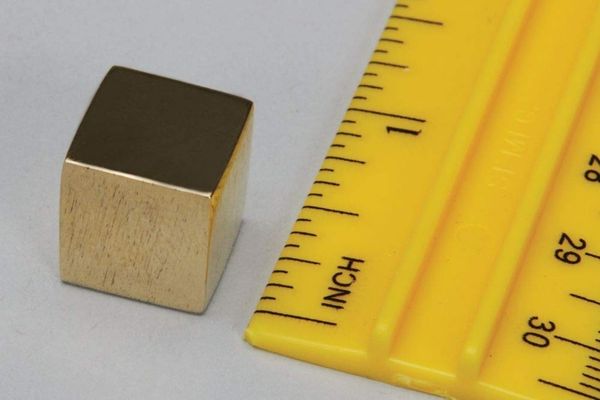
I learned this the hard way when I was ordering material for some custom cabinet handles. I did my calculations in metric, but the supplier in the US used imperial units. I mixed up the conversion and ended up ordering almost twice the amount of brass I needed. It was an expensive mistake! Let’s make sure that doesn’t happen to you. Most of the world uses the metric system (g/cm3), but in the United States, we often use imperial units like pounds and inches for materials and construction.
Understanding the Conversion
The math to switch between the systems is straightforward once you know the conversion factor. One gram per cubic centimeter is equal to 0.0361273 pounds per cubic inch.
1 g/cm3 = 0.0361273 lb/in3
So, if we take a common brass alloy like Cartridge Brass (C260), which has a density of 8.53 g/cm3, the calculation is:
8.53 g/cm3 × 0.0361273 = 0.3081 lb/in3
It’s helpful to see the different units side-by-side.
| Unit System | Unit of Mass | Unit of Volume | Common Brass Density Range |
|---|---|---|---|
| Metric (SI) | Grams (g) | Cubic Centimeters (cm3) | 8.4 – 8.73 g/cm3 |
| Imperial/US | Pounds (lb) | Cubic Inches (in3) | 0.303 – 0.315 lb/in3 |
| Metric (SI) | Kilograms (kg) | Cubic Meters (m3) | 8400 – 8730 kg/m3 |
Knowing this conversion is super important for practical reasons. If you’re buying material for a project, calculating shipping costs, or doing any engineering, you’ll need the right density for your units.
Is brass denser than steel?
Wondering if brass is denser than steel? It can be tricky to guess just by holding them in your hands. Let’s compare the numbers and find out the surprising truth.
Yes, brass is generally denser than steel. The density of brass ranges from 8.4 to 8.73 g/cm3. Most common steels, like carbon steel and stainless steel, have a density of about 7.85 g/cm3. So, a piece of brass will be heavier than a same-sized piece of steel.
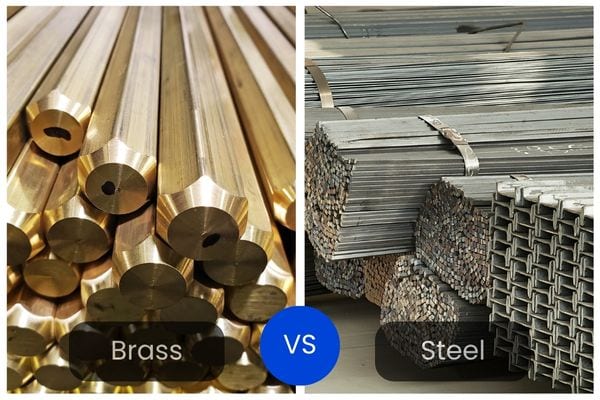
I was really surprised by this during a metalworking class. I picked up a small brass fitting and a larger steel bolt. The small brass piece actually felt heavier in my hand. It was a perfect real-life lesson in density. The brass was packing more mass into a smaller space. This might seem backward at first. We often think of steel as being the stronger, “heavier” material. While steel is often stronger, it is usually not denser. The reason goes back to the elements they are made from.
A Closer Look at the Numbers
The main component in brass is copper (8.96 g/cm3). The main component in steel is iron (7.87 g/cm3). Copper is naturally denser than iron. Even when copper is mixed with lighter zinc to make brass, the resulting alloy is still denser than most common steels.
| Material | Main Elements | Typical Density (g/cm3) | Typical Density (lb/in3) |
|---|---|---|---|
| Brass (Avg.) | Copper, Zinc | ~8.5 | ~0.307 |
| Carbon Steel | Iron, Carbon | ~7.85 | ~0.284 |
| Stainless Steel | Iron, Chromium, Nickel | ~7.9 | ~0.285 |
Now, it’s good to know that both “brass” and “steel” are huge families of alloys. There are some very specialized steels, like those mixed with tungsten, that can be much denser than brass. But for almost all common situations, brass is the denser material. This is why brass often gives a feeling of quality and heft in things like high-end plumbing fixtures, musical instruments, and decorative hardware.
Which is denser, gold or brass?
Brass looks so much like gold, but is it just as heavy? Its shiny, yellow color can be very deceiving. Let’s compare their densities to see the massive difference between them.
Gold is much, much denser than brass. Pure gold has a density of 19.32 g/cm3. This is more than double the density of typical brass, which is around 8.5 g/cm3. If you held a gold bar and a brass bar of the exact same size, the gold would feel shockingly heavier.
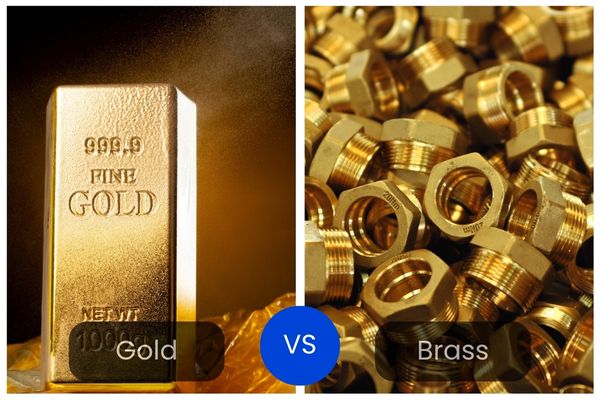
I was lucky enough to hold a real one-kilogram gold bar at a museum exhibit once. Later that same day, I remember picking up a brass doorstop that was about the same size. The difference was incredible. The gold felt unnaturally heavy, like it was actively trying to pull my hand down. It’s a feeling you don’t forget, and it’s because gold packs an incredible amount of mass into a small volume. It’s a great reminder that looks can be deceiving.
Why Is Gold So Dense?
The reason for this huge difference is found in basic chemistry. Gold (Au) is a very heavy element on the periodic table. Its atoms are naturally very heavy, and they pack together extremely tightly. Brass, on the other hand, is an alloy of much lighter elements. Its main components, copper (Cu) and zinc (Zn), are much lower on the periodic table and have lighter, less compact atoms.
| Property | Gold (Au) | Brass (Common Alloy) |
|---|---|---|
| Appearance | Yellow, metallic | Yellowish, similar to gold |
| Type of Substance | Pure Element | Alloy (Copper + Zinc) |
| Density (g/cm3) | 19.32 | ~8.5 |
| Density (lb/in3) | 0.698 | ~0.307 |
This massive density difference is one of the classic ways to tell real gold from fake gold. A piece of “fool’s gold” or even gold-plated brass will feel way too light for its size if you know what real gold feels like. It’s a simple physics test that has been used for centuries to spot a counterfeit.
Conclusion
In short, brass density depends on its specific alloy. It’s generally denser than steel but is far less dense than gold. Always check the alloy for precise measurements.