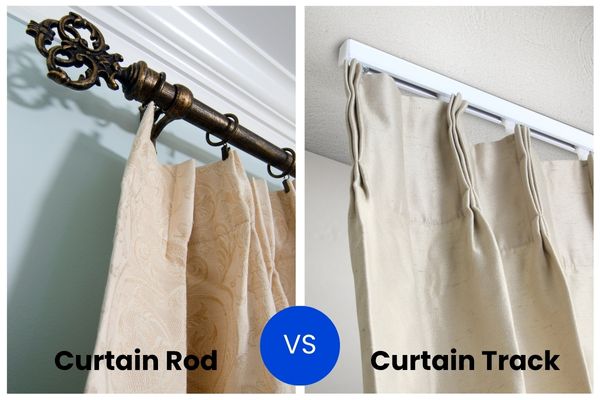
I often talk to people about home design. A common problem comes up again and again. You spend weeks picking the perfect curtains. You find a fabric and color you love. But then you face a new challenge: how will you hang them? This brings you to the big question: Should you use a curtain rod or a curtain track?
This choice is more than just a small detail. It affects how your curtains look and how they work every single day. A curtain rod is often a bold, decorative piece. A curtain track is usually a quiet, functional system that stays out of sight.
In this guide, I will walk you through everything. We will look at style, function, cost, and how to install each one. After reading, you will know exactly which option is right for your home. You can then make your choice with confidence.
A Head-to-Head Comparison Table
If you need a fast answer, here is a simple table. It breaks down the main differences between curtain rods and curtain tracks.
| Feature | Curtain Rod | Curtain Track |
|---|---|---|
| Aesthetics | Decorative, part of the design | Discreet, hidden, minimalist |
| Functionality | Good for standard windows, manual operation | Excellent for smooth gliding, motorization options |
| Best For | Style statements, lightweight to medium curtains | Heavy curtains, bay windows, room dividers, ceilings |
| Installation | Generally simpler for DIY, requires fewer tools | Can be more complex, requires precise measurement |
| Cost | Wide range, very affordable to very expensive | Often a higher initial investment, but durable |
| Curtain Types | Grommet, Tab Top, Rod Pocket, Rings | Pinch Pleat, Ripplefold, Pencil Pleat |
What is a Curtain Rod?
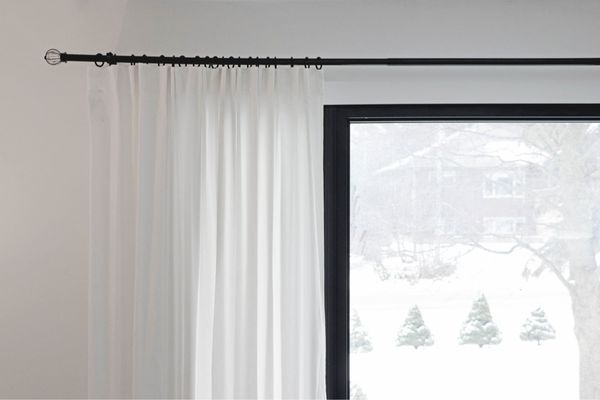
A curtain rod is probably what you picture first when you think of hanging curtains. It’s a classic and popular choice in many homes.
How it Works & Key Components
The system is very simple. It uses a long pole that holds the curtains. This pole is supported by brackets that you attach to the wall. At the ends of the pole, you have finials. Finials are the decorative caps that screw onto the ends. They stop the curtains from sliding off and add a lot of style. You can hang curtains on a rod in a few ways. You can slide the rod through a pocket in the curtain fabric, thread it through grommets (metal rings), or use separate rings that clip onto the curtain.
Types of Curtain Rods
Not all rods are the same. Here are the main types you’ll find:
- Single Rod: This is the most common type. It’s one pole used for one layer of curtains. It’s simple and does the job for most windows.
- Double Rod: This system uses two rods, one in front of the other. It’s perfect for a layered look. For example, you can have a light, sheer curtain on the back rod and a heavy blackout curtain on the front one.
- Tension Rod: This is a great solution for renters. It uses a spring inside the rod to create tension between two walls. You don’t need any screws or drills. But, it can only hold lightweight curtains and works best in smaller window frames.
Pros & Cons of Curtain Rods
- Pros: The biggest advantage is style. You can find rods and finials in countless designs, materials, and colors. They become part of your room’s decoration. They are also easy to find in most stores and are usually easy to install yourself.
- Cons: A long rod can start to bend or sag in the middle if it’s holding heavy curtains. To fix this, you need a center support bracket. But, this bracket can stop the curtain rings from sliding all the way across. Rods are also not great for bay windows or curved walls without special, and sometimes clumsy, connectors.
What is a Curtain Track?
A curtain track is a more modern and functional system. Its main job is to work perfectly, not to be seen.

How it Works & Key Components
A curtain track is a slim channel made of metal or plastic. Inside this channel, small gliders or carriers move back and forth. You attach your curtains to these gliders using small hooks. Because the gliders are inside the track, they move very smoothly. There are no brackets to get in the way. This means you can open and close your curtains with almost no effort.
Types of Curtain Tracks
Tracks offer a lot of flexibility. Here are the common types:
- Wall Mount vs. Ceiling Mount: You can mount a track on the wall above the window, like a rod. Or, you can mount it directly to the ceiling. A ceiling-mounted track can make a room feel taller and more grand.
- Flexible Tracks: Some tracks are bendable. You can shape them by hand to fit perfectly into a bay window or around a curved wall. This is something a standard rod cannot do.
- Corded vs. Uncorded: An uncorded track means you pull the curtain itself or use a small wand attached to the first glider. A corded track has a pulley system with a cord at the side. You pull the cord to open and close the curtains, so you never have to touch the fabric.
Pros & Cons of Curtain Tracks
- Pros: Tracks are very strong. They are the best choice for very heavy curtains, like thermal or velvet drapes. They give you a smooth, effortless glide every time. They are perfect for wide windows, ceiling-to-floor drapes, and tricky spaces like corners. You can also hide them for a clean, minimalist look.
- Cons: Tracks are not decorative. The whole point is to hide them. The installation can be a bit harder than a rod. You need to measure carefully to make sure the track is perfectly straight. They can also cost more than a basic curtain rod.
The Detailed Breakdown: Rods vs. Tracks by Category
Now, let’s dive deeper into the key areas you should think about.
Aesthetics & Visual Impact
Your choice here depends on one question: do you want to see the hardware? If the answer is yes, choose a rod. A beautiful brass rod or a modern matte black rod can be a key part of your design. You can match the finish to your light fixtures or door handles. If the answer is no, choose a track. A track lets the curtains be the main feature. A hidden ceiling track with ripplefold curtains gives you a clean, high-end look, like in a luxury hotel.
Functionality & Ease of Use
When it comes to pure function, tracks often win. A track can hold much more weight than a rod without sagging. This makes it the clear choice for heavy blackout curtains. Tracks also provide a smoother operation. The gliders move freely from end to end. With a rod, curtain rings can sometimes snag on the pole or get stuck at the center support bracket.
Installation: DIY vs. Professional Help
In my experience, a curtain rod is usually easier to install. You need a drill, a level, and a screwdriver. Most people can do it themselves in under an hour. A curtain track can be trickier. Getting it perfectly level is very important, especially on the ceiling. If the track isn’t straight, the gliders might not work properly. A confident DIYer can handle it, but sometimes it’s best to hire a professional.
Cost & Budgeting
People often think tracks are much more expensive, but that’s not always true. A simple plastic track kit can be cheaper than a fancy decorative rod with expensive finials. It is helpful to think of cost in tiers. A simple tension rod is the cheapest. Then comes a basic rod kit, then a basic track kit. A custom-bent track or a high-end decorative rod will cost the most.
When to Choose a Curtain Rod vs. a Track?
I know that making the final choice can be tough. So, I have created this simple guide to help you. Use this checklist to see which option fits your home and your needs the best.

Choose a Curtain Rod if…
- …You feel the hardware should be a visible, stylish part of your room’s design.
- …Your windows are a standard shape and size.
- …Your curtains are light or medium in weight.
- …Your curtain style is a rod pocket, tab-top, or has grommets (metal rings).
- …You are renting and need an option that does not require drilling holes, like a tension rod.
Choose a Curtain Track if…
- …Your curtains are very heavy, very long, or cover a very wide area.
- …You have a tricky window shape, like a bay, a corner, or a curved wall.
- …You want to hang your curtains from the ceiling to create a sense of height.
- …You prefer a clean, modern, and minimalist look where the hardware is invisible.
- …You need to use a curtain as a flexible room divider.
- …You might want to add a motor to open and close your curtains automatically in the future.
Frequently Asked Questions (FAQ)
Here are answers to a few more questions I hear all the time.
Q1: Can you hang pinch pleat curtains on a rod?
A: Yes, you can. You just need to use special curtain rings that have a small loop or eyelet at the bottom. You then insert a drapery pin into the back of the pinch pleat and hook it onto the ring’s eyelet.
Q2: Are curtain tracks out of style?
A: Not at all. In fact, they are very popular right now. Interior designers love them for creating clean, modern, and high-end looks. The “invisible” hardware look is very much in style.
Q3: Which is better for blackout curtains, a rod or a track?
A: A track is better for blackout curtains for two reasons. First, tracks can handle the heavy weight of blackout fabric better. Second, you can get tracks with a “return,” which is a curve at the end that brings the curtain right to the wall. This blocks light from seeping in around the sides.
Q4: How do I hide a curtain track?
A: The easiest way is to mount it to the ceiling and hang a long curtain that covers it. You can also hide it behind a pelmet or a cornice, which is a decorative box-like structure built above the window.
Our Verdict: The Right Choice for Your Home
So, which is better, a curtain rod or a track? The true answer is that the “better” option is the one that fits your needs.
Think of it this way: choose a rod for decoration, and choose a track for function. If you want to make a style statement with beautiful hardware on a standard window, a rod is a fantastic choice. If you have a functional challenge, like a heavy curtain, a huge window, or a curved wall, a track is almost always the superior solution.
Now you have all the information to look at your windows and decide with certainty.